Note 04 / cyclical sea edge
Surf behind the traffic
On Alexandria’s Corniche, the Mediterranean and the road do not take turns. Wave sets, wind and vehicle pulses overlap, separate and return at different scales.
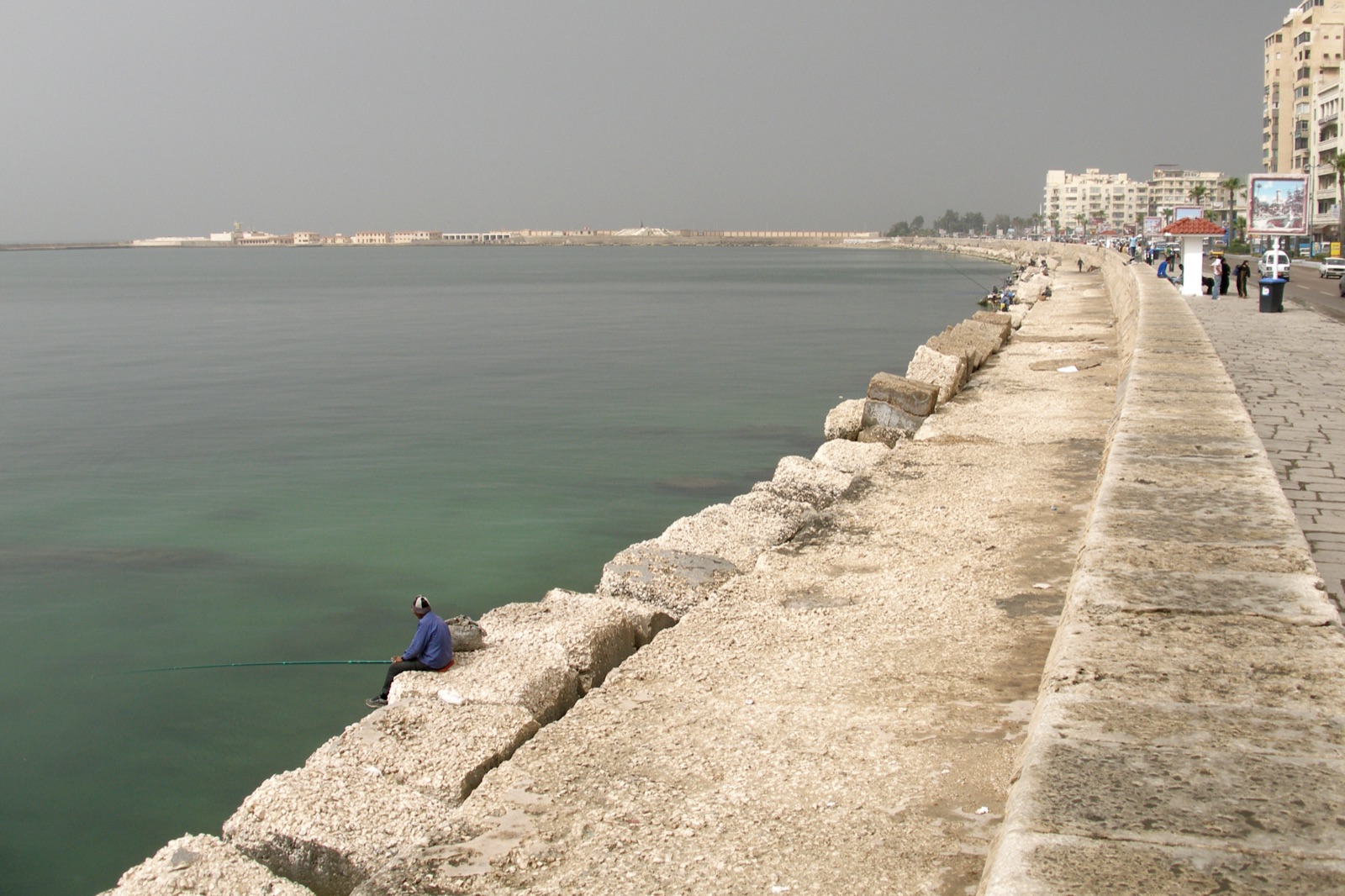

Choose a legal, protected position well back from spray, slippery stone and traffic. Do not climb a barrier or walk onto a breakwater for a cleaner recording. From the safe side, begin with two broad bands: sea and city. The exercise is to discover how much variation exists inside each one, not to decide which band deserves to win.
Waves arrive in groups
A sea edge rarely produces identical impacts at even intervals. Watch and listen for a short set: approach, break, wash, retreat. One wave may strike a vertical surface; another spends itself across lower rock; a third arrives while the previous water is still returning. Mark the strongest event and the quieter internal motion that follows it.
After several sets, ask which part repeats. It may be the interval between larger impacts, a gravelly retreat, or a low continuous wash beneath sharper contacts. Avoid counting too quickly. Traffic and wind can hide the beginning or end of a wave, making a broken pattern appear more regular than it is.
Two-band timeline
Draw sea events above a horizontal line and road events below it. Use long marks for continuous bands and short marks for impacts or horns. Circle moments when one band masks the other.
The road has pulses too
Traffic is often described as an unbroken wall. Hold attention longer and gaps appear. A cluster approaches, fills the near lane, thins, and leaves a short opening. Different vehicles contribute different durations and pitches, but identifying types is less important than mapping the pulse.
During a road gap, the sea may seem suddenly louder even when the waves have not changed. That contrast is a reminder: perceived prominence depends on competition. Record “sea revealed during gap,” not “sea increased,” unless visible wave conditions also changed.
Wind joins both sides
Wind activates railings, clothing, vegetation and the microphone itself. It also changes wave conditions, though a casual listener should not infer a full forecast from sound. Turn your head slightly and test whether a rough low noise follows your ears or equipment. If it does, label it as self-noise before attributing it to the sea.
A handheld recorder can exaggerate wind dramatically. A technically ruined recording may still be an ethically unnecessary one. Do not respond by moving into a hazardous or restricted position. Make a written diagram instead.
Sea walls divide and connect
Built edges change where water meets the city. Open gaps, rock armour, steps and vertical walls produce different visible contacts. Compare only what is safely observable from the public route. A hard impact near one section and a softer wash near another may reflect geometry, wave angle and local conditions together.
The wall also carries people. Walkers, vendors, fishers, families and workers are not background characters in a soundscape. Avoid pointing a microphone toward conversations or work activity. If a person is likely to be recognisable, ask before recording—and explain how the file would be used or shared.
Refuse the authenticity contest
The Mediterranean is not the authentic layer hidden beneath modern traffic, and traffic is not the whole sound of Alexandria. Both are part of a coastal city shaped by movement, infrastructure and weather. A careful listener can value the wave cycle without turning everyday urban life into contamination.
Listen once with attention toward the water and once toward the city while keeping the same position. The source balance will change because attention is selective. Note that shift rather than claiming the whole environment changed.
Finish by noting the safe position, wind direction if known, visible sea condition and the approximate density of the road. These conditions prevent the map from pretending to describe every day. The photographed coastline is a setting reference, not a live report.
Five attentive minutes are enough. When spray rises, conditions worsen or the route becomes crowded, stop. The strongest field practice at a sea edge is often the decision to step back before the next set arrives.