Note 01 / moving waterline
The Nile between boats
At Aswan, a river view can change before a sentence is finished. A felucca enters, an engine crosses behind it, a wake reaches stone later, and the bank answers in another rhythm.
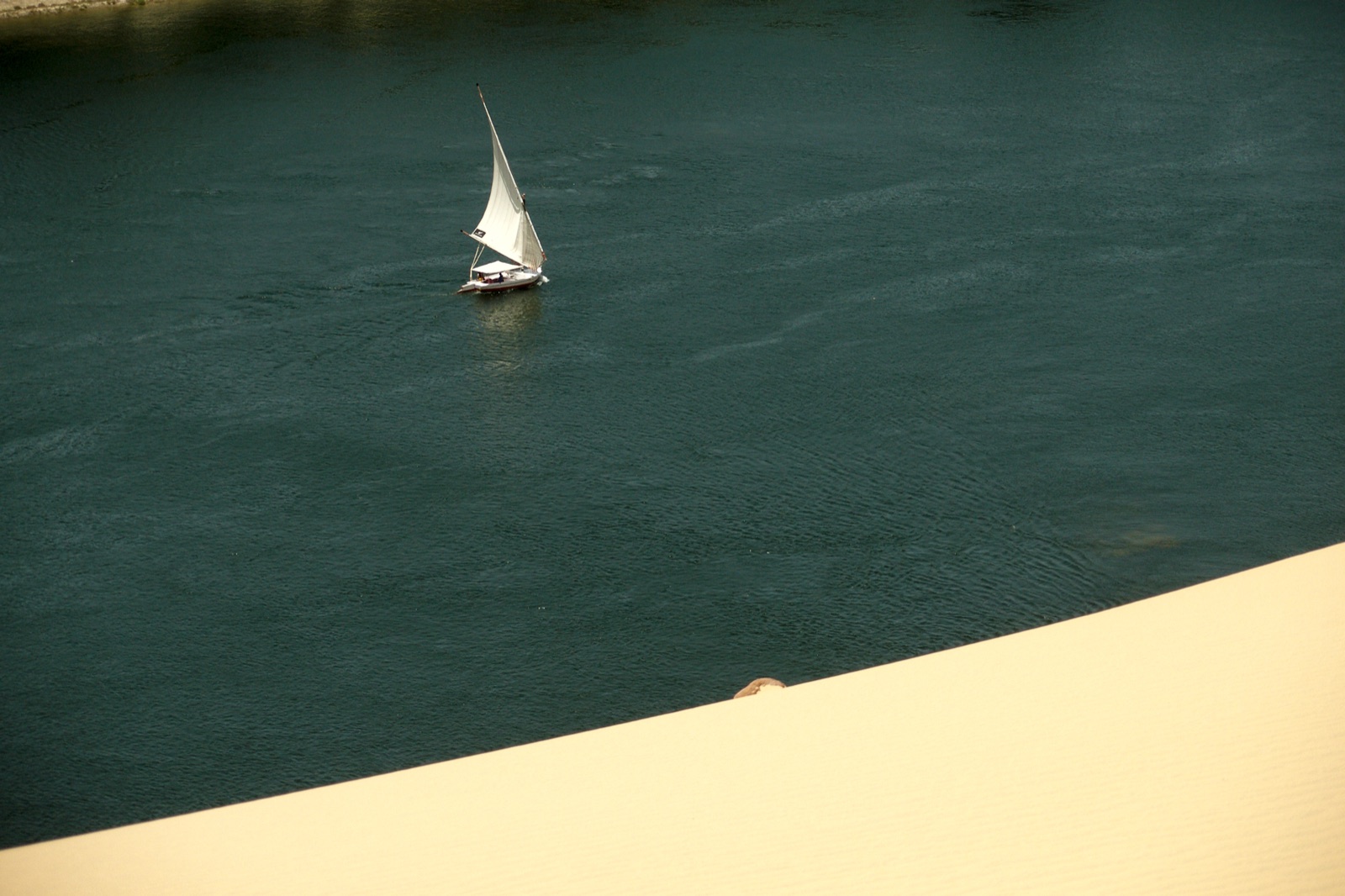

Begin by refusing the phrase “the sound of the Nile.” A river channel has no single track. Water touches hull, stone, mud and reeds differently. Voices cross from boats and banks. Engines arrive as low pulses, grow broader, then thin behind an island. Wind makes rigging and cloth audible only when angle and tension allow it. The useful unit is not a sound object but a relationship that changes position.
Follow an arrival all the way through
Choose one boat while it is still far away and listen without turning the scene into a test of vessel names. Mark the first moment you notice it. The sound may precede a clear view, or the sail may be visible before any distinct noise reaches you. As it crosses the middle distance, other sources can mask part of its movement. Continue until it passes, recedes or becomes indistinguishable from the background.
This complete arc—emergence, growth, overlap and disappearance—is more informative than a short loud segment. It also prevents a common field-note mistake: treating a moving source as though it occupied one fixed point.
Two-line river note
Line one: draw the bank, channel and far edge. Line two: mark when a source enters, becomes clearest, is masked and leaves. Add a delayed wake only when you actually hear or see it reach the edge.
Water is an event, not a bed
Quiet-looking water may still contain small impacts and repeating friction. Listen near the closest edge first. Is the pattern regular, linked to wakes, or changed by a moored object? Then move attention outward. The open channel may seem less detailed because distance blends small events, not because nothing is happening there.
A passing wake produces a useful sequence. Its visible line travels; its sound at your bank arrives later. This delay makes distance tangible. Record the relationship without guessing speed or depth. A simple note—“wake visible mid-channel, three stronger contacts at the stone edge later”—keeps observation separate from calculation.
Do not rank sail above engine
It is tempting to label a felucca as the authentic quiet layer and motor traffic as intrusion. That story is too easy. Working river life includes different technologies, purposes and tempos. A sail can produce knocks, rope movement, voices and hull contact; a distant engine can become a soft continuous band. The listening task is to describe their acoustic behaviour, not to award cultural purity.
Engines often mask finer sounds temporarily. When one passes, notice what returns first. A close rope tap may reappear before a far voice; reeds may remain audible through part of the engine band. Masking is selective, and the return reveals the scene’s distance structure.
The bank is part of the instrument
Stone steps, vegetation, walls and open soil change what reaches the listener. A hard edge can return short impacts clearly. Reeds generate their own near detail and obscure sight lines. A sheltered inlet may reduce the direct effect of current while admitting voices from above. Describe the immediate surface beneath and behind you; the listening position is never acoustically neutral.
Human movement matters too. Choose a place where stopping is safe and does not obstruct work, access or passage. Do not step onto moorings or private boats to obtain a cleaner sound. If a crew or passenger becomes identifiable in a recording, consent questions arise even when the river itself is public.
Leave with a moving map
End the note by drawing arrows, not by naming every source. One arrow can show a boat crossing, another the wind, and a third the later arrival of wake at the bank. Add a bracket for a masking interval. The map will remain useful even if the exact craft, voice or bird was uncertain.
Conditions on the Nile vary with location, time, weather, water movement and traffic. This essay is a listening method, not a promise of a quiet sail or a current report from Aswan. The most honest river note preserves change—and accepts that the next five minutes may sound entirely different.